

On Oct. 26, Hurricane Melissa hit the west coast of Jamaica, tearing through buildings and terrain with winds up to 185 mph.
What was supposed to be a low-category hurricane quickly intensified into a Category 5, ranking among the strongest hurricanes ever.
Despite the distance between Jamaica and Normal West, however, the hurricane still had a big impact on the school.
Normal West science teacher, Valentine Walker, born and raised in Jamaica, has family members who still live there, and English teacher, Justin Smith, was visiting Jamaica for a family wedding, when the hurricane hit.
As of a few days ago, there are reported to be 67 deaths caused by the hurricane, and many others were injured or missing.
The storm caused most homes and businesses to be left with no power, and stable cell service was rare.
Reports vary on how much the damages in Jamaica will cost, but many predict it will cost roughly four billion dollars just for Jamaica.
For the Caribbean region as a whole, the estimate could be tens of billions.
As the storm begun to run its course, airports in Jamaica quickly cancelled any flights in or out of the country to protect the safety of passengers. This left many stranded…including Smith.
Celebration quickly turns into ‘survival-mode’ for Smith family
Smith was in Jamaica for his niece’s wedding.
What was meant to be a four-day trip quickly turned into 11 days as there was little to no traffic in or out of the country.

While staying at the Royalton Resort in Montego Bay, Smith, who was originally in a room facing the beach, was later moved, along with others at the resort, to higher, inward-facing rooms to hunker down and wait out the storm.
The weather in the days leading up to the storm was calm–nothing like what the island had yet experienced.
“The two days before the hurricane were probably some of the most beautiful weather to experience on the island,” Smith said.
However, as the days went on, all flights in and out of the country had been canceled, which made people staying at the resort begin to grow uneasy.
“I started to get anxious because all of the flights got cancelled, and the storm was moving so slowly that the power was increasing,” Smith added.
When the storm hit, all residents at the resort were moved into a conference room transformed into a shelter to be protected from the “catastrophic wind and rain,” Smith explained.
It was there that Smith and his family waited the storm out.
After the storm ran its course, it was clear that around the area of Montego Bay, destruction was everywhere.
The houses of the wealthy, which were higher up on the mountains and made of stone, looked as if they were untouched by the extreme weather, according to Smith.
However, there were other areas of the island completed demolished.
With Jamaica hurting, Smith and his family found that trying to get back home proved to be extremely difficult.
In fact, they quickly learned that the only flights leaving the island were from a city three hours away from where Smith was staying.
After a three-hour bus ride and a four-and-a-half-hour plane ride to Toronto, Smith was officially back in North America.
Then, Smith and his family drove eight hours to Chicago to drop off his mother.
Eventually he made the two-hour drive back to Bloomington on November 3.
“I was emotionally, physically, mentally, and financially drained from trying my hardest to get back home,” Smith shared.
After being stuck in Jamaica during the strongest hurricane the island has seen in years, Smith expressed his gratitude for finally making it home.
“At the end of the day, I am thankful to be home and have a sense of normalcy, but it will take some time before I am truly okay,” Smith expressed.
Walker family looks for help after devastation to family home
While Mr. Smith was in the middle of the storm, West science teacher Valentine Walker watched the disaster unfold from the U.S., anxiously following updates about his family still in Jamaica, (specifically St. Elizabeth).
Not only is Walker’s family from Jamaica, but he also spent the beginning of his childhood there.
“I was born in Jamaica in 1972. I lived there up until 1997,” he said.
“I went to elementary and high school there and even got my undergrad in Jamaica before moving [to the U.S.].”
His strong connection to the island made hurricane Melissa especially difficult to witness from afar.
Walker first learned about the storm while he was traveling in Oregon.
“It had been brewing for a while,” he said.
“I called my mom and siblings in Jamaica after hearing about it on the radio. They were just outside gardening, instead of preparing, so I was a bit agitated,” he noted.
After some convincing, his family started taking the storm seriously.
“After much prompting from me with a few choice words, they decided to put reinforcements over the

windows, nail down the roof, and bring family members to my mom’s house because it’s more structurally sound.”
When Hurricane Melissa hit Jamaica, Walker managed to stay in touch briefly.
“I was talking to my mom around the moment the hurricane hit, around 11:00 a.m. that morning. By that time, she had lost a good portion of her roof and was hiding in a room without windows,” he recalled.
Soon after, communication became nearly impossible.
“We lost a lot of contact because there’s no electricity: the phones die, the cell towers don’t work. Luckily, we’ve had one or two spotty connections here and there. It’s very frustrating and also causes a lot of anxiety because you don’t know what’s really going on down there,” Walker recalled.
For Walker, trying to teach and coach in a sectional championship for the Normal West boys soccer team while worrying about his family was a major challenge.
“It’s been a challenge, to be honest with you,” he said.
“I had to focus on my job while knowing my family was in danger. It was a good model for my students, showing that even when you’re going through rough things, you can still function in a day-to-day job and so on,” he added.
Walker said that while people tend to focus on the hurricane itself, the true hardship often comes afterward.
“People don’t understand that catastrophic events like this don’t end with the storm. There’s no running water, and diseases are spreading because of poor sanitary conditions. Landslides are happening because the ground is oversaturated with water. Beaches have lost all their sand, and some are just rocks now. The smell of decay from all the dead animals is everywhere,” he described.
According to Walker, the hurricane’s effects have created long-term issues for the country’s economy and tourism.
“Those beaches are what draw people to Jamaica. Now…some resorts won’t survive,” he noted.
Even though he couldn’t be there physically, Walker has been helping however he can.
“Sometimes it’s actually better for me to be here trying to raise funds and send money,” he explained.
“If I go down there, I’d just be another person in line for food and water. This way, I can send help directly to my family and community.”
Walker’s mother lost most of the roof on her home, so much of the funds that Walker and his family are raising will help to repair that.
The roof has been temporarily covered with a blue tarp, but the home will need a fully replaced roof in order to make it completely safe and livable again.
Walker’s story shows that even from thousands of miles away, the emotional impact of hurricane Melissa reached far beyond the island itself.
Although Normal West is far from Jamaica, the effects of hurricane Melissa impacted school staff in profound ways.
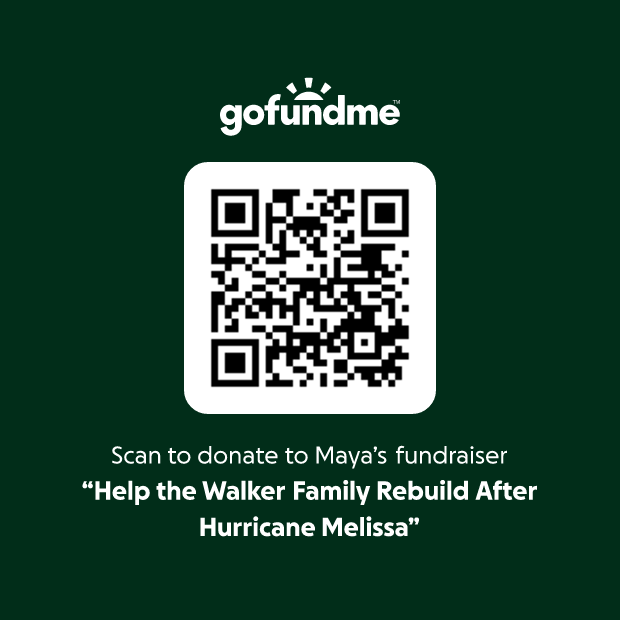
To help the Walker family recover from the damages of Hurricane Melissa, please scan the QR code.
According to the GoFundMe page set up by Maya Walker, they are looking to “[raise] $10,000 USD to help repair and replace the roof so [Walker’s mother] can have a secure, dry home once more. The funds will go directly toward roofing materials, labor, and basic repairs to restore the house.”