

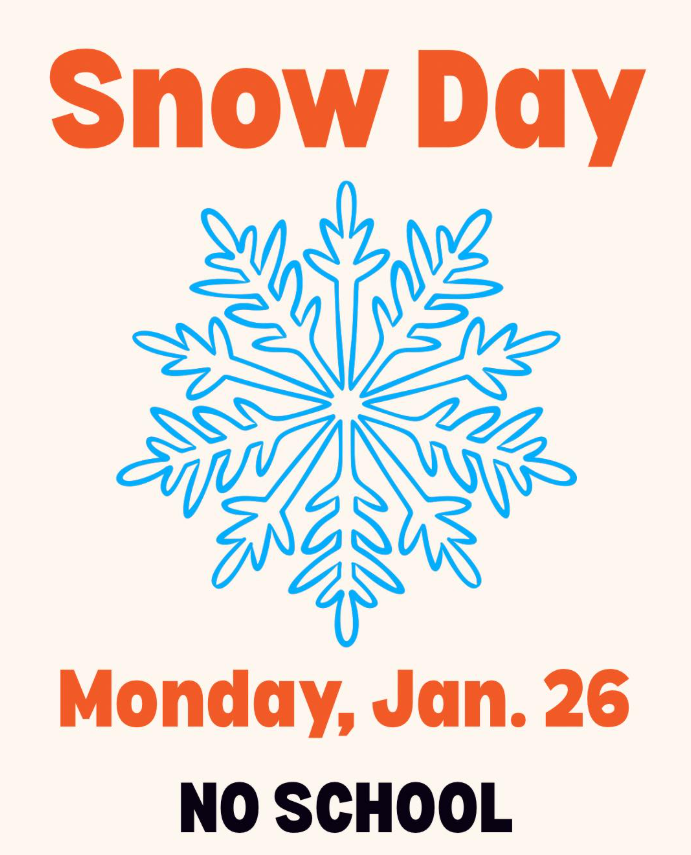
As students, we love Snow Days.
It’s a free day with no school, no homework, and no boring lectures to attend. But what really goes into a Snow Day?
Snow days, also known as “emergency days,” are days that are declared when certain weather conditions make it difficult for students to attend school.
Typical snow days are determined by analyzing specific data points such as snow accumulation, ice, and extreme windchill before school begins.
It is ultimately the superintendent’s decision to organize snow days as she closely monitors updates from the National Weather Service.
“I always use the National Weather Service out of Lincoln to look at the most recent updates and so we look at snow accumulation for like Friday and Monday, we were really focused more on the wind chill and not necessarily wind chill throughout the whole day but at the times that students would be either waiting for a bus outside or walking to school,” Superintendent of Unit 5 schools, Dr. Kristen Kendrick-Weikle, stated.
When extreme weather days are predicted, Weikle and other officials pair with National Weather Service meteorologists to get the most up-to-date information within the area.
“Either myself or someone else will sit in and listen to updates when we think there’s going to be really extreme weather, whether it’s wind chill, or snow, or ice, sometimes the National Weather Service will do calls where we’ll sit in and we get the most up-to-date information from meteorologist in our area… that work for the National Weather Service. They’re looking at lots of data points so they’ll do a call with many of us. I’m in communication with our internal operations and maintenance people…” Weikle stated.
The primary focus for these conditions involve transportation.
Weikle worries about students who will be outside either walking school, or waiting for buses, especially elementary students whose pickups usually begin as early as 6 a.m.
“…Sometimes people forget that we have three tiers of transportation. Our elementary students start getting on the [buses] really early like we have some kids picked up as early as 6:00 a.m.,” Weikle added.
The district buses carry diesel and according to Weikle, they have to start the buses each weekend to ensure that they will run the following school day.
It is important to consistently start-up these buses because extremely cold weather will cause the diesel to gel up, preventing them from running and transporting students.
Many students are affected by these harsh weather conditions, and students in rural areas are most at risk for dangerous travel as the roads may not be cleared up as fast as main roads. Student athletes are also at risk when travelling on the weekends.
“… The road commissioners will tell us ‘like yes we haven’t even touched the county roads yet or nope we’re in good shape we’ve been able to get out and apply salt and clear them.’ We talked to the town of normal officials, we talked to the city of Bloomington officials to also know what kind of conditions those roads [are] in…” Weikle added.
“We’re more than 214 square miles so that’s a lot of difference as we have to consider those rural routes whereas that’s not.”
When faced with the threat of inclement weather, Weikle converses with other district officials, such as District 87 officials, to get a general idea of what her next step is.
“We talked to the town of Normal officials; we talk to the city of Bloomington officials to also know like what kind of conditions are those roads in and then myself, I usually talk to District 87 officials [at] ISU, [and] Heartland Community College to talk about what everyone is doing…” Weikle stated.
Communication goes a long way as Weikle makes sure to discuss with maintenance and road commissioners about their ability to clear the snow and salt the roads in time for others to travel.
Alongside the process of snow days, there is a heavy debate with Snow Days vs. E-learning days.
According to Weikle, they try not to have consecutive E-learning days back-to-back to avoid issues with connectivity.
Many families argue that E-learning is ineffective, so the district tries their best to encourage balance between the two days for better productivity.
“I don’t love the idea of having two e-learning days back to back primarily for elementary kids especially when we’ve had a weekend in between so there’s a break and learning they had e-learning on Friday we know we had some connectivity issues then we had Saturday Sunday off it just didn’t feel good or right to have another e-learning day particularly for our elementary kiddos…” Weikle added.
Throughout the community, there are mixed reactions among parents and their opinions between Snow and E-learning days.
“No matter what we decide somebody’s mad and so when we did e-learning on Friday, some people are really happy and then some people emailed like e-learning’s worthless, it’s a waste of time my kids aren’t on or there’s connectivity issues [and] it wasn’t really a productive day or other people saying we think this was a great decision…” Weikle expressed.
“We surveyed families earlier this fall as far as kind of their preference. Over 60% of our family said they prefer an e-learning day over a snow day but over 25% of our family said they really preferred a combination so we try to kind of keep all of those things in mind…”
In general, the timing of an announcement is released as early as Sunday Night. Giving families enough time to prepare for the following days.
For weekend competitions and trips, communication regarding weather conditions releases as early as 5:30a.m.